
Puzzleprime Science
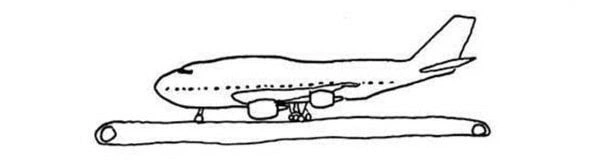
Solution coming soon.
When the ammonia (NH3), found in cleaning fluids, is mixed with bleach (a dilute solution of sodium hypochlorite, NaOCl), a deadly gas (monochloramine, NH2Cl) is produced that can kill a person instantly. The resulting chemical reactions are the following:
Bleach decomposes, forming hydrochloric acid and subsequently chlorine gas:
NaOCl → NaOH + HOCl
HOCl → HCl + O
NaOCl + 2HCl → Cl2 + NaCl + H2O
The chlorine gas reacts with the sodium hypochlorite in the bleach, releasing chloramine as a vapor:
2NH3 + Cl2 → 2NH2Cl


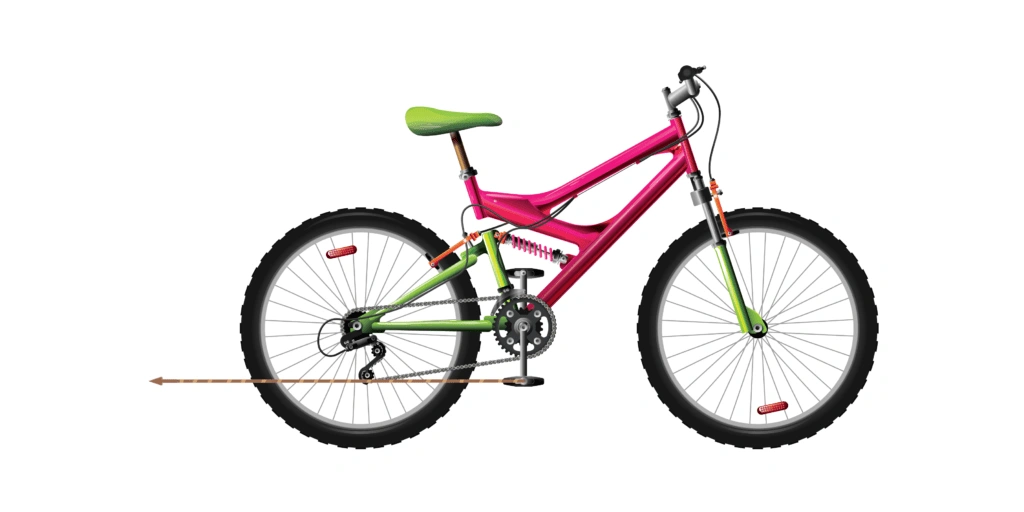

The surprising answer is that (usually) the bicycle will move backward.
When a bicycle moves forward, the trajectory its pedal traces with respect to the ground is called a trochoid. Depending on the selected gear of the bicycle, that trochoid could be:
Curtate trochoid (for almost all gears of most bicycles)
Prolate trochoid (if the gear is very low and the bicycle moves slowly)
Common trochoid, a.k.a. cycloid (if the wheels of the bicycle and the pedal spin at identical speeds, practically never happens)
curtate trochoid
prolate trochoid
common trochoid (cycloid)
Since we are fixed with respect to the ground, by pulling the pedal backward, we are causing it to move leftward along the trochoid and therefore the bicycle will be moving backward. We note that despite that, the pedal will be moving forward with respect to the bicycle (but not with respect to the ground).
You can see a visual explanation of this puzzle in the video below.

It will remain the same. The amount of water that the ice cube displaces is equal to its mass. Since the mass does not change and the density of water is equal to 1, the extra water after melting will be the same amount as the displaced water before that.
Unlike humans, birds need gravity in order to swallow. Thus, in space they wouldn’t be able to drink and will die of dehydration.
If there is no wind force to help you escape, what are you going to do to avoid freezing to death?
Throw your phone as hard as you can. Thanks to Newton’s third law of motion and the frictionless lake, you will start sliding away.
The angle will measure the same, 12°.
The reason the balloon floats up in the air is that the helium has a lower density, so when gravity pulls the denser air around down, the balloon gets pushed up. Similarly, when the car accelerates, the air around gets drawn to the back of the car, which makes the helium balloon go forward.
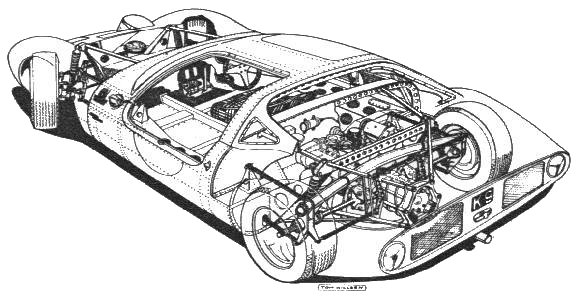
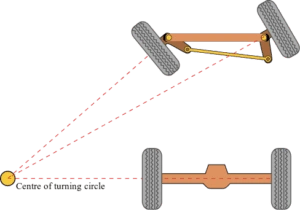
The front wheels are not parallel to each other. The reason is that when steering, all wheels are turning along arks that have a common center. Otherwise, the car would be drifting.
Simply roll the two cylinders on the ground. The hollow one will roll farther than the solid one since it will have a higher moment of inertia.