Written by the RobloxGame.app Editorial Team
Last Updated: July 1, 2026
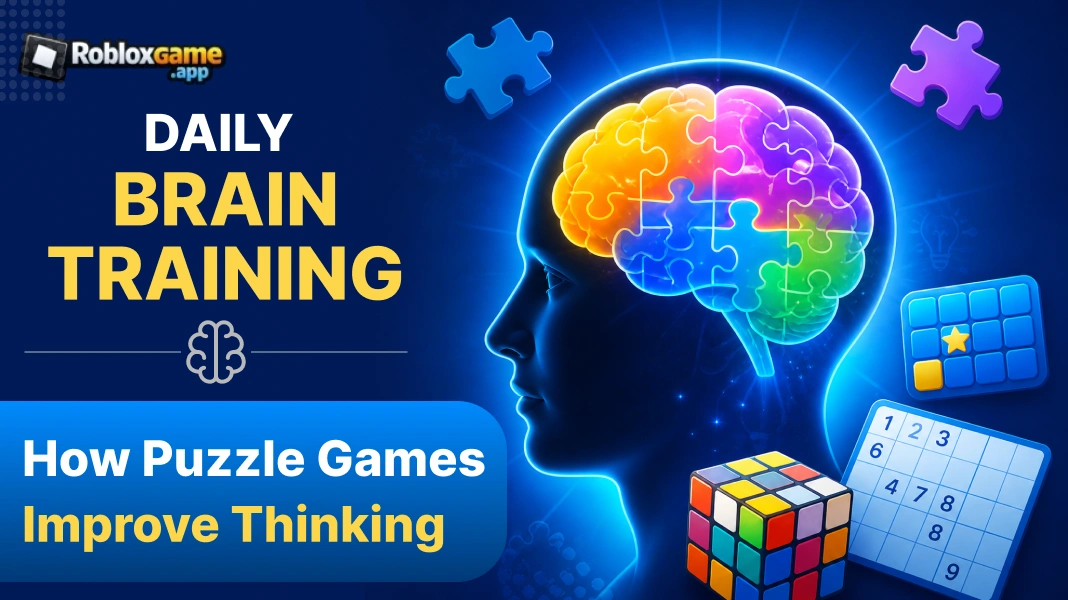
Daily brain training is an easy way to keep your mind busy with little puzzles. You do not need to study for a long time or use complicated tools. Playing puzzle games, sudoku, riddles, or logic games for just a few minutes can help you practice memory, focus, and problem-solving skills in a fun way.
Puzzle games are good for you because they keep your brain busy. You need to think, try out ideas, remember clues, and make plans rather than just watching or scrolling. This is why a lot of people like to play brain games every day.
In this guide, you will find out how puzzle games can help you think better, which ones are best for brain training, and how to make a simple habit that works for kids, students, and adults.
What Is Daily Brain Training?
Daily brain training is the practice of doing short mental tasks every day to improve your thinking skills. Some of these activities are puzzles, memory games, sudoku, riddles, math problems, word games, and logic games.
You do not have to be perfect right away. The goal is to keep your mind active and improve the way you think over time.
Mental practice can make puzzle-solving feel more familiar over time, especially when you play with focus and patience. A daily puzzle plan can be very helpful because it is easy to start and does not need any downloads.
How Puzzle Games Support Thinking Practice
Puzzle games improve thinking by giving your brain problems to solve. Each puzzle asks you to look at information, understand the rules, and choose the best answer.
Here are the main thinking skills puzzle games can support.
Focus and Attention
- Most puzzle games need you to pay close attention. Miss one clue, number, or pattern, and you might get the wrong answer. That pushes you to slow down and focus.
- Take Sudoku. You have to check every row, column, and box before placing a number. That kind of focused thinking trains your attention in a calm, steady way.
Memory Practice
- Many brain games ask you to remember things for a short time. You might need to recall where a card was, which numbers are missing, or which clues we already used.
- This helps your working memory — the skill of holding information in your mind while solving a problem.
Logical Thinking
- Logic puzzles teach you to think step by step. Rather than guessing, you compare clues and cross out wrong answers.
- For example, if a puzzle says an answer can not go in a certain spot, you use that clue to thin things down. This builds clear reasoning skills.
Problem-Solving Skills
- Puzzles are really just problems. Some are easy, some take more time and strategy.
- When you solve puzzles regularly, you practice breaking major problems into smaller steps. That is one of the most useful habits you can learn.
Best Puzzle Games for Daily Brain Training
Different puzzle games train different mental skills. A good brain-training plan should include a mix of game types.
1. Math Puzzle Games
- Math puzzle games are great for number skills, pattern recognition and logical thinking. These could be missing numbers, equations, sequences or quick maths problems.
- You do not need any fancy math to enjoy them. Most math puzzles are not about hard calculations, but finding patterns.
2. Sudoku
- Sudoku is a useful game for practicing focus and logic. The rules are simple: fill the grid with numbers, so that each row, each column and each box contains the right numbers without repetition.
- Sudoku is good for training patience, as it often includes mistakes when you guess. You have to watch, compare and choose carefully.
- If you want a calm, daily puzzle, try Sudoku brain training. Start from the easy level and then go to the harder puzzles.
3. Logic Puzzle Games
- Logic puzzles are a good way to think in a structured way. They often have clues, rules, patterns or mystery-style challenges.
- These games teach your brain to ask better questions, like: What do I know? What could I remove? Which answer fits all the clues?
- To get better at reasoning, try logic puzzle games and challenge yourself with clue-based puzzles.
4. Riddles and Puzzles
- Riddles are good for creative thought. They play with words in simple ways, so the answer might not be easily apparent.
- A riddle can teach your brain to think differently, question theory and look beyond the first answer.
- Short breaks are also a good time to do a brain teaser, as they are fast and fun.
5. Memory Matching Games
- Memory matching games are simple but effective. You need to remember the position of images, cards, symbols, or numbers.
- These games are useful for short-term memory and visual attention. They are also easy for beginners and good for many age groups.
6. Word Puzzle Games
- Word searches, crosswords, and logograms support word-stock, spelling, and recall. They also help your brain connect clues with possible answers.
- Word puzzles are a good choice when you want a lighter brain-training activity that still keeps your mind active.
How to Build a Daily Brain Training Routine
A good plan needs to be simple. You can stop after a few days if you find it too hard.
Begin with 10 to 15 minutes a day. Pick one or two puzzle games and play them with your full attention.
Here is a simple weekly schedule:
- Monday: math, puzzles
- Tuesday: sudoku
- Wednesday: Puzzles
- Thursday: Riddles
- Friday: word games
- Saturday: games of memory
- Sunday: mixed puzzle workout
This gives diversity to your brain and keeps the training interesting.
You can also mix Sudoku, math puzzles, riddles, word games, and memory games based on your interest and skill level.
Tips to Get Better Results from Brain Games
Playing puzzle games is helpful, but how you play matters too.
1. Pick the right difficulty
- A good puzzle feels challenging but not impossible. Too easy, and you won’t improve much. Too hard, and you will just get frustrated.
2. Do not rush
- Speed will come with time. Focus on being accurate first. Make sure you understand the puzzle clearly.
3. Learn from your mistakes
- If you pick the wrong answer, stop and ask why. Did you miss a clue? Guess too early? Misread the rule?
4. Mix different types of puzzles
- Sudoku, math puzzles, riddles, and logic games all train different skills. Playing a variety gives your brain a better workout.
Are Brain Games Enough by Themselves?
Brain games are useful, but they are only one part of a healthy mind plan.
- Reading
- Learning new skills
- Getting enough sleep
- Staying active
- Taking breaks from screens
It’s also important to be realistic. Puzzle games can help with focus, memory, logic, and problem-solving. But they won’t boost your intelligence overnight.
The real benefit comes from playing regularly and thinking actively.
Conclusion
Playing puzzle games every day is a fun and easy way to work on your memory, focus, logic, and problem-solving skills. Start with short sessions, pick games you like, and mix up the types of puzzles you do during the week. Every little challenge, like sudoku, math puzzles, riddles, or logic games, can help you keep your mind sharp.
Frequently Asked Questions
Every day, you should do short mental activities like puzzles, sudoku, riddles, memory games, or logic puzzles. This is called daily brain training. The goal is to keep your mind busy and work on your thinking skills.
Puzzle games can help you practice memory, focus, logic, and problem-solving skills. They promote active thinking, careful reading, and logical reasoning.
Ten to fifteen minutes a day is a good place to start. Short, focused sessions are usually better than long ones where you do not pay attention.
Sudoku, math puzzles, logic puzzles, riddles, memory games, and word puzzles are all good options. A mix of different games gives better mental practice.